Idea
A humanoid platform with room to grow
Pilot-to-platform roadmap, service and deployment responsibilities.
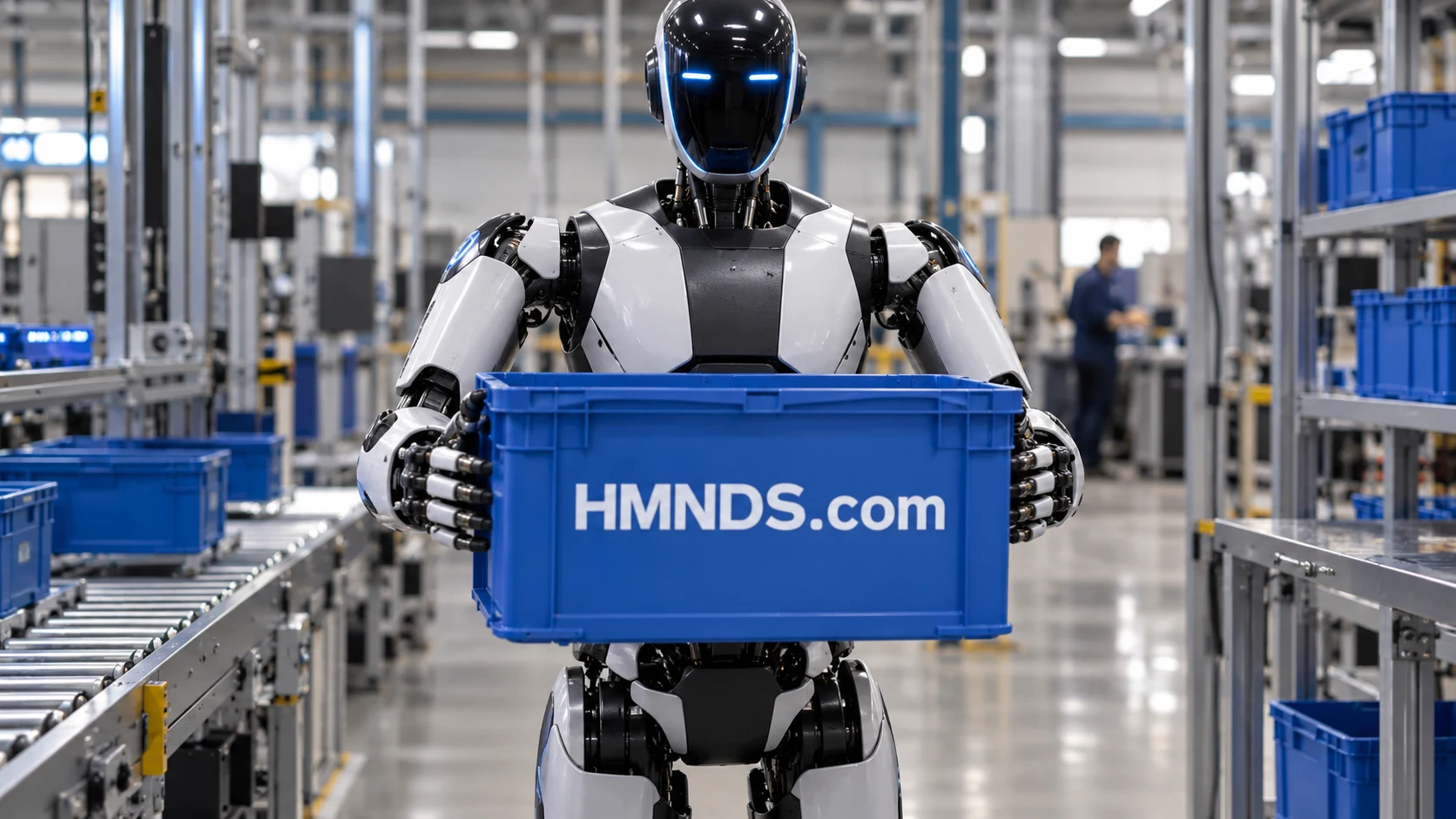
An illustrative business concept for HMNDS.com
A humanoid hardware brand becomes easier to understand when its first offer is smaller than its ambition. Instead of introducing a robot as a general answer to industrial work, start with one task, one environment and a support arrangement a customer can evaluate. HMNDS.com could serve as the parent identity for that offering, with a plain descriptor explaining the product. This concept is a planning direction, not a description of an existing HMNDS business.
Choose the first customer's task
The first buyer might be a plant operations team with a repeatable material movement problem. The task description should identify the object, the starting position, the destination and the conditions that make a run successful. “Move these containers between two marked stations during a defined window” is more useful than “improve productivity.” It lets both parties discuss handling, access, timing and exceptions before comparing robot capabilities.
There is public precedent for manufacturers framing humanoids around industrial work. Boston Dynamics presents Atlas in the context of material handling. That is a statement about its own product positioning, not evidence that a proposed HMNDS platform can perform the same work. A new hardware business would need its own observations, tests and customer acceptance process.
Ask the customer to describe the surrounding workflow. Who loads the first station? Who clears the destination? What happens when an object is missing, damaged or placed incorrectly? A robot may complete its motion while the wider process still fails. The initial offer should say which steps belong to the robot system and which remain with people or other equipment. That boundary becomes the basis for a credible demonstration.
Make the pilot offer concrete
A pilot package could contain site preparation, installation, operator orientation, a bounded test period and a written report. Each item needs an owner and a deliverable. Site preparation might end with a reviewed layout and an agreed access plan. Installation might end with a checklist signed by the participating teams. Orientation should describe what operators practice, who is authorized to intervene and where questions go afterward.
The commercial structure should reflect the work being supplied. A development partner accepting uncertain performance is different from a customer purchasing a supported product. Make that distinction visible in the proposal. Explain which components are experimental, which are supported and which results are being evaluated. A buyer should be able to tell what they are paying to learn, what they are paying to operate and what happens when the pilot ends.
Service is part of the platform
A hardware brand has to answer questions beyond the robot's physical design. Who responds when a system stops? Which spare parts are available? How are software changes approved? Where are maintenance records kept? A proposed platform should document those responsibilities before placing several robots with several customers. The support model will shape staffing, training and cost as directly as the hardware specification.
Start with a service map for one site. Put the operator, customer contact, remote support team and field service role on the same page. Assign routine checks, fault investigation and escalation. Include a path for stopping work when the condition is unclear. The map should use real role titles and working contact routes once the business exists. A diagram containing only abstract departments will leave the customer with unanswered questions.
Build an evidence trail
The pilot report should record attempted cycles, completed cycles, interventions and excluded time separately. A single success percentage can conceal the reason a deployment is difficult to operate. For example, repeated object repositioning by a person deserves its own entry even if the robot completes the final movement. Note the condition, the intervention and the time required so the next test can address the actual problem.
A short video can help explain an event, but it should be tied to the run record. Preserve the date, software version, task conditions and relevant changes. A selected clip is useful communication; it is not the entire operating history. The platform's customer materials should distinguish a demonstration from a report covering an agreed test window. That distinction becomes more valuable as the number of deployments grows.
Let the second product follow the evidence
Expansion could mean another task on the same robot, another environment for the same task or a new hardware model. Those are different development decisions. A second task may require different handling and perception. A second environment may change access and lighting. Another hardware model may change service inventory and training. Keep a written reason for the chosen expansion rather than treating all three as one roadmap item.
The parent brand can hold that growth together. Product pages could describe individual models, task packages and service plans beneath HMNDS. The domain would provide one recognizable destination for prospects, operators and partners. Naming alone does not solve the operational work, but consistent product labels can help customers find the material relevant to their installed system.
Reach buyers through a task they recognize
Early distribution should center on the chosen workflow. A useful introduction includes a one-page task brief, a description of the supported environment and the questions the pilot will answer. A conversation with a plant team can then focus on whether that task exists at its site. Broad outreach to every possible industry will make the product harder to assess and the learning harder to compare.
The next step is to write the first customer task in enough detail that someone else can observe it. Include the starting condition, completion condition, intervention rules and responsible people. Then review that sheet with a prospective operator before building a wider platform story. If the task cannot be described clearly, the first offer is not ready to be described as a product.

About Michael Santiago
Michael founded i-Newswire.com in 2007, later iNewswire.com and Newswire.com. That business sold to Issuer Direct for $44 million in 2022. He develops premium domains and companies through OnlineBusiness.com, exploring how a clear identity can support products such as the humanoid concepts presented here.
Make it human
Inquire about HMNDS.com
Discuss the domain and its fit for your plans.
Inquire to purchase